
Heating guide
Truma Heating and Hot Water Guide
Learn how to use the Truma CP Plus and Combi system with more confidence, from everyday heating and hot water settings to common fault checks and cold-weather troubleshooting.
The Most Important Advice…
Check the Basics First
Before assuming the heater has failed, work through the simple checks first. Many Truma problems come down to low battery voltage, the wrong energy source, blocked vents, a drained boiler, or a FrostControl valve that has opened in cold weather.
- Confirm the habitation battery has enough charge
- Check whether you are on gas, electric, or mixed mode
- Make sure warm air outlets and intake areas are clear
- Check the gas bottle, regulator, and isolation valves
- See whether the FrostControl valve has drained the boiler
Start With the Main Controls
Heating Modes
- Use Heating Only for cabin warmth
- Use Water Only for summer hot water
- Use Heating and Water for the most common touring setup
Hot Water Settings
- Eco is usually around 40°C
- Hot is usually around 60°C
- Boost may be available for faster heating on some systems
Energy Source
- Use gas for off-grid touring
- Use electric when on hook-up
- Use mixed mode for faster warm-up in colder weather
Fan and Timer
- Automatic fan mode is usually best for everyday comfort
- Use timers to warm the van before breakfast
- Set hot water in advance before showers or washing up
Common Issues to Check First
Low Voltage
- Codes such as #24, #44, #302 and #303 can point to a weak habitation battery
- Check battery voltage before assuming the heater has failed
- Use the Control Panel Guide if you need help reading system status
Airflow and Overheating
- Codes like #18, #402 and #150 can be caused by blocked vents or restricted intake areas
- Check for disconnected ducting or items covering warm air outlets
- Make sure airflow can move freely around the system
Gas and FrostControl
- Confirm the gas bottle, regulator, isolation valves, and flue are all clear
- Check whether the FrostControl valve has opened and drained the boiler
- Read the Truma Frost Valve guide for cold-weather support
Everyday Setup
- Check that the right mode is selected for the result you want
- Confirm you have mains hook-up if using electric heating
- Review the basics before booking a repair visit
Understanding the CP Plus Control
This layout helps you understand what each numbered area on the Truma CP Plus controller does before you start changing settings, switching energy sources, or troubleshooting a fault.
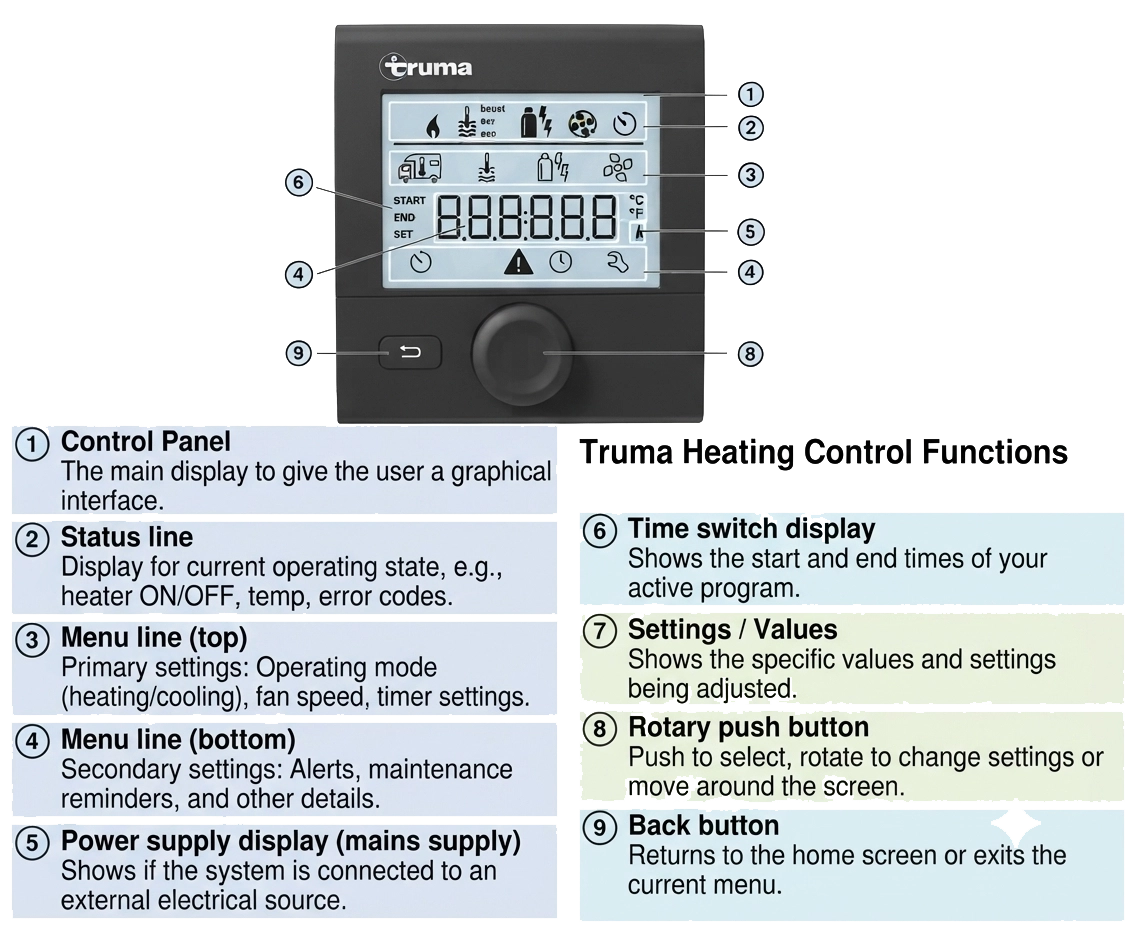
Display Areas
- 1. Control Panel — The main display that gives the user a graphical interface.
- 2. Status line — Shows the current operating state, such as whether the heater is on or off, the temperature setting, and any error codes or messages.
- 3. Menu line (top) — The primary display area where key information or settings are shown, such as current temperature, operating mode, fan speed, or timer settings.
- 4. Menu line (bottom) — A secondary display area that shows additional information, alerts, reminders, or related options.
- 5. Power supply display (mains supply) — Indicates whether the heating system is connected to an external mains power source.
Buttons and Settings
- 6. Time switch display — Shows the start and end times of your program.
- 7. Settings / Values — Shows the settings you are changing in the various functions.
- 8. Rotary push button — Lets you move to the desired part of the application, select settings by pressing, and change values by rotating.
- 9. Back button — Returns you to the home screen or exits the menu you are currently using.
Once you know where these controls sit, everyday tasks like changing heating mode, checking hook-up status, or setting timers become much easier.
Questions You Should Answer First
What is Mixed mode?
Mixed mode uses gas and electric together for the fastest warm-up, which is especially useful in winter or when you want hot water quickly.
Why will the heater not start?
Start by checking battery voltage, gas supply, hook-up status, the window above the flue, and whether any vents or intake areas are blocked.
Why is there no hot water?
The boiler may be empty, the water mode may be off, or the FrostControl valve may have opened in cold weather and drained the system.
Should I use gas or electric?
Use electric on campsite hook-up to save gas, and use gas when touring off-grid or when you need heating away from mains power.
What if a fault code appears?
Many codes relate to low voltage, blocked vents, gas supply problems, or a cold FrostControl valve, so work through the basics before arranging a repair.
Troubleshooting Fault Codes
An error code is shown on the display of my digital CP plus control panel – how do I find out what it means?
Combi gas heater
| Code | Meaning | What to do |
|---|---|---|
| #17 | Summer mode with empty water container | Switch heater off and allow to cool. Fill boiler with water. |
| #18 | Warm air temperature exceeded: not all warm air ducts are connected, warm air outlets blocked, circulated air intake blocked | Check whether the 4 warm air ducts are connected; check the individual outlet openings; remove the circulated air intake blockage. |
| #21 | Room temperature sensor or cable faulty | Inspect the room temperature sensor cable, replace if faulty. Check the resistance of the room temperature sensor: 15 °C – 16.2 kOhm / 20 °C – 12.6 kOhm / 25 °C – 10.0 kOhm. Replace room temperature sensor if faulty. |
| #24 | Risk of low voltage. Battery voltage is too low < 10.4 V | Charge battery. |
| #29 | Frost Control heating element has a short circuit | Disconnect heating element plug from electronic control unit. Replace heating element. |
| #42 | Open window above cowl (window switch) | Close window. |
| #43 | Overvoltage > 16.4 V | Check battery voltage / voltage sources such as the charger. |
| #44 | Low voltage. Battery voltage is too low < 10.0 V | Charge battery. If necessary replace old battery. |
| #45 | No 230 V operating voltage, 230 V fuse defective, overheating protection has been triggered | Restore 230 V operating voltage; replace 230 V fuse (see Combi operating instructions); reset overheating protection (see Combi operating instructions). |
| #112 | Gas cylinder empty | Replace gas cylinder. |
| #112, #121, #122, #202, #211, #212 | Gas flow issues: gas cylinder empty; gas cylinder or quick-acting valve in the gas supply line closed; gas pressure regulation system iced up; butane content in the gas cylinder too high; combustion air infeed or exhaust outlet is sealed; gas pressure regulation system faulty | Replace gas cylinder; check gas supply and open valves; use regulator heater (EisEx); use propane because butane is unsuitable for heating below 10 °C; inspect openings for obstructions and remove them; inspect / replace gas pressure regulation system. |
| #255 | Heater has no 12 V power supply, no connection between heater and control panel | Ensure 12 V power supply; make connection between heater and control panel. |
Combi gas heater from 04/2018
| Code | Meaning | What to do |
|---|---|---|
| #255 | Heater has no 12 V power supply, no connection between heater and control panel | Ensure 12 V power supply; make connection between heater and control panel. |
| #301 | Overvoltage > 16.4 V | Check battery voltage / voltage sources such as the charger. |
| #417 | Overvoltage > 16.4 V | Check battery voltage / voltage sources such as the charger. |
| #302 | Low voltage. Battery voltage is too low < 10.0 V | Charge battery. If necessary replace old battery. |
| #418 | Low voltage. Battery voltage is too low < 10.0 V | Charge battery. If necessary replace old battery. |
| #303 | Risk of low voltage. Battery voltage is too low < 10.4 V | Charge battery. |
| #411 | Risk of low voltage. Battery voltage is too low < 10.4 V | Charge battery. |
| #401 | Summer mode with empty water container | Switch heater off and allow to cool. Fill boiler with water. |
| #402 | Warm air temperature exceeded: not all warm air ducts are connected, warm air outlets blocked, circulated air intake blocked | Check whether the 4 warm air ducts are connected; check the individual outlet openings; remove the circulated air intake blockage. |
| #407 | No 230 V operating voltage, 230 V fuse defective, overheating protection has been triggered | Restore 230 V operating voltage; replace 230 V fuse (see Combi operating instructions); reset overheating protection (see Combi operating instructions). |
| #412 | Open window above cowl (window switch) | Close window. |
| #507, #516, #517 | Gas flow issues: gas cylinder empty; gas cylinder or quick-acting valve in the gas supply line closed; gas pressure regulation system iced up; butane content in the gas cylinder too high; combustion air infeed or exhaust outlet is sealed; gas pressure regulation system faulty | Replace gas cylinder; check gas supply and open valves; use regulator heater (EisEx); use propane because butane is unsuitable for heating below 10 °C; inspect openings for obstructions and remove them; inspect / replace gas pressure regulation system. |
| #607 | Max. number of fault resets reached | Wait 15 minutes and reset fault. |
| #621 | Room temperature sensor or cable faulty | Inspect the room temperature sensor cable, replace if faulty. Check the resistance of the room temperature sensor: 15 °C – 16.2 kOhm / 20 °C – 12.6 kOhm / 25 °C – 10.0 kOhm. Replace room temperature sensor if faulty. |
| #624 | Frost Control heating element has a short circuit | Disconnect heating element plug from electronic control unit. Replace heating element. |
Combi Diesel heating system
| Code | Meaning | What to do |
|---|---|---|
| #111 | Room temperature sensor or cable faulty | Inspect the room temperature sensor cable, replace if faulty. Check the resistance of the room temperature sensor: 15 °C – 16.2 kOhm / 20 °C – 12.6 kOhm / 25 °C – 10.0 kOhm. Replace room temperature sensor if faulty. |
| #122 | Lack of fuel due to insufficient fuel tank filling, tank has run empty and / or vehicle is on a slope | Fill tank with fuel. Then fill the fuel line as described in Initial startup (see Combi Diesel operating instructions). |
| #132 | Frost Control heating element has a short circuit | Disconnect heating element plug from electronic control unit. Replace heating element. |
| #150 | Warm air temperature exceeded: not all warm air ducts are connected, warm air outlets blocked, circulated air intake blocked | Check whether the 4 warm air ducts are connected; check the individual outlet openings; remove the circulated air intake blockage. |
| #151 | Water temperature exceeded in winter mode: water temperature sensor excessive temperature, warm air outlets blocked, circulated air intake blocked | Switch off appliance and allow it to cool down. Fill boiler with water; check the individual outlet openings; remove the circulated air intake blockage. |
| #152 | Water temperature exceeded in summer mode: water temperature sensor excessive temperature, warm air outlets blocked, circulated air intake blocked | Switch off appliance and allow it to cool down. Fill boiler with water; check the individual outlet openings; remove the circulated air intake blockage. |
| #160 | Undervoltage < 10.2 V | Check battery voltage, charge if necessary. Short-term immediate measure: switch off major consumers or start up the vehicle engine until the heater starts to operate (approx. 4 minutes). Battery capacity inadequate, if necessary exchange old battery. |
| #161 | Overvoltage > 16.4 V | Check battery voltage / voltage sources such as the charger. |
| #162 | Open window above cowl (window switch) | Close window. |
| #164 | No 230 V operating voltage, 230 V fuse defective, overheating protection has been triggered | Restore 230 V operating voltage; replace 230 V fuse (see Combi operating instructions); reset overheating protection (see Combi operating instructions). |
| #255 | Heater has no 12 V power supply, no connection between heater and control panell | Ensure 12 V power supply; make connection between heater and control panel. |
Air conditioning system
| Code | Meaning | What to do |
|---|---|---|
| #1 | Failure (short circuit or broken cable), room temperature sensor | Contact Truma Service. |
| #2 | Ice sensor (inside) triggered | Inspect the filter and replace it if necessary. |
| #4 | Ice sensor (outside) triggered | Keep the air inlets / outlets on the roof free of obstructions such as leaves. |
| #8 | IR receiver unplugged or cable broken | Check the connection of the IR receiver. |
| #17 | Voltage drop at 230 V power supply | Check 230 V power supply. |
If the same code keeps returning after you have checked the basics, it is usually best to stop resetting the system and arrange a proper inspection.
Final Thoughts
Once you understand the Truma CP Plus basics, everyday heating and hot water control becomes much more straightforward. Most issues can be narrowed down quickly by checking voltage, energy source, airflow, and the FrostControl valve before moving on to deeper fault finding.
If you want more support, explore the related guides on Truma Frost Valve, Control Panel Guide, and Solar Energy for practical help with life on the road.