
Tech & Guides
Motorhome Tyres – The Full Story
A practical Roller Team Club guide to CP tyres, axle loads, pressures, tread law, storage, all-season suitability, and how to read the markings on your tyre sidewall.
Why CP tyres are recommended
CP tyres are designed specifically for campervans and heavy motorhomes. They are recommended because motorhomes often run close to their axle limits, spend long periods parked between trips, and place sustained load on the rear axle. A CP tyre is built to cope better with those conditions than a standard passenger-car tyre.
- They are intended for higher, more constant loads common in touring vehicles.
- They are better suited to prolonged standing than many standard car tyres.
- They support the pressure levels commonly specified for motorhome rear axles.
- They are the tyre type widely recommended by motorhome manufacturers for heavier coachbuilt layouts.
Since 2003, ETRTO guidance has supported the use of CP tyres for motorhomes because of the unique loading and usage pattern of these vehicles. For many owners, especially those with heavier rear axle loads, CP remains the most appropriate specification.
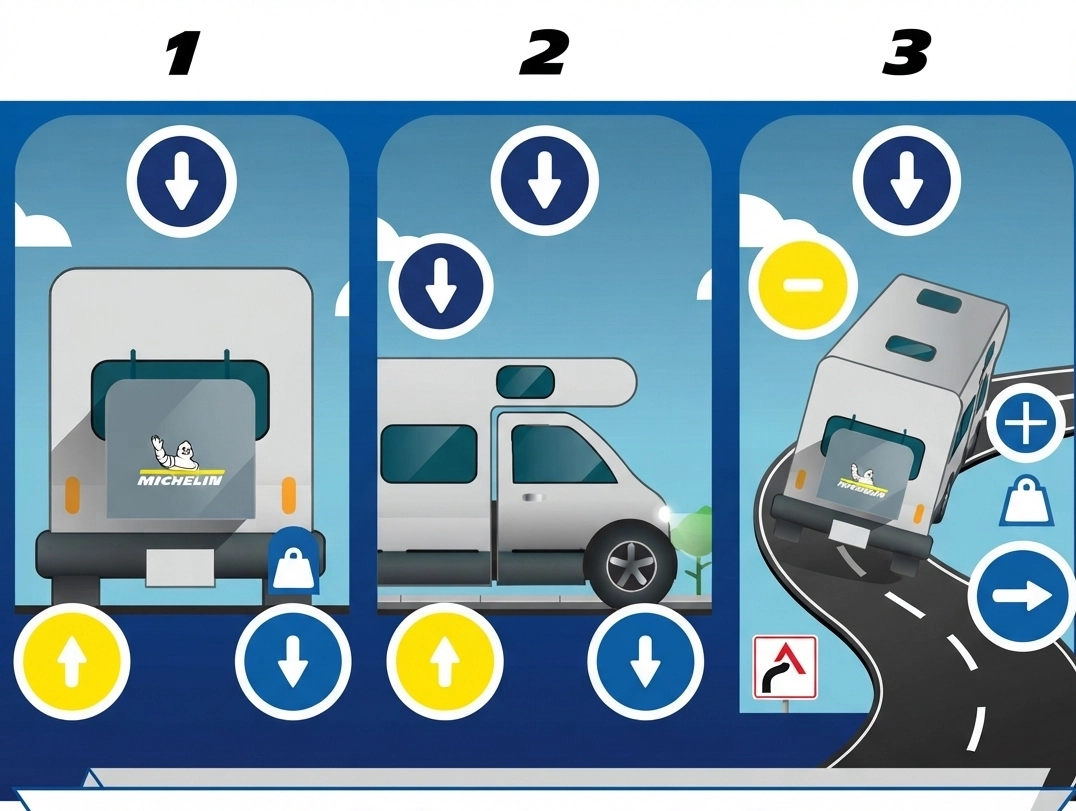
This load illustration helps explain why motorhome tyres need higher load capacity and why rear axle specification matters so much.
Loads and pressure
Why higher load capacity is needed
A motorhome may look similar to a van, but its operating weight is often much higher and less evenly distributed. Rear garages, water tanks, batteries, bikes, passengers, and touring kit all add stress to the tyres, especially at the back.
Pressure guidance
- Rear axle guidance for CP motorhome tyres is commonly set at 5.5 bar (80 psi).
- Front axle pressure should follow the motorhome manufacturer recommendation for your model and axle loading.
- Always check pressures when tyres are cold.
- Check tyre pressures monthly and again before any long journey.
Why it matters
Under-inflation increases heat build-up, weakens handling, and accelerates shoulder wear. Over-inflation can reduce the contact patch and make the ride harsher. The correct pressure is not guesswork. It should match the tyre type, axle load, and the vehicle maker’s published guidance.
For heavy motorhomes, tyre choice and tyre pressure work together. The right CP tyre with the right load index and the right pressure is what keeps the vehicle stable and safe.
Roller Team Club
Things to Watch Out For
Cracking
Look for cracks:
- Sidewalls
- Between tread blocks
- Around the bead near the wheel rim
Small cosmetic cracks aren’t unusual, but deeper cracks mean replacement.
Tread Depth
Legal minimum UK:
- 1.6 mm across the central ¾ of the tread.
For motorhomes:
- I’d replace at around 3 mm.
- Wet grip drops noticeably below this.
Uneven Wear
Look for:
- More wear on one edge
- Centre worn more than edges
- Feathering
- Cupping
Usually indicates:
- Incorrect pressure
- Alignment issues
- Suspension wear
Probably the most overlooked item is the Date
- Find the DOT code on the tyre.
- The last four digits show the week and year of manufacture.
- Example: 2322 = Week 23 of 2022.
- Check carefully after 5 years.
- Consider replacement around 7 years on motorhomes, even if tread looks good.
- Many manufacturers advise replacing by 10 years at the latest.
Why it matters
Under-inflation increases heat build-up, weakens handling, and accelerates shoulder wear. Over-inflation can reduce the contact patch and make the ride harsher. The correct pressure is not guesswork. It should match the tyre type, axle load, and the vehicle maker’s published guidance.
For heavy motorhomes, tyre choice and tyre pressure work together. The right CP tyre with the right load index and the right pressure is what keeps the vehicle stable and safe.
Roller Team Club
Correct Pressure
Always check when tyres are cold.
Don’t simply use the maximum pressure on the tyre.
Use:
- Vehicle manufacturer’s recommendations
- Better still, axle weights if you’ve had the motorhome weighed.
Legal basics
Tread depth, risks, and penalties
UK and Europe
For vehicles under 3.5 tonnes, the legal minimum tread depth is generally 1.6 mm across the central three-quarters of the tread and around the full circumference of the tyre. That is the key rule in the UK and is widely mirrored across Europe, though local enforcement details can vary by country.
Why worn tyres are risky
Worn tyres reduce wet grip, lengthen braking distances, increase aquaplaning risk, and can make a heavily loaded motorhome much less stable in emergency manoeuvres.
Possible penalties
Driving on illegal tyres can lead to fines, penalty points, failed inspections, insurance complications, and the possibility of separate penalties for each defective tyre.
Storage
Recommendations for prolonged parking
- Check and set pressures before storage.
- Move the motorhome occasionally if practical to reduce flat spotting.
- Avoid parking for long periods on contaminated ground, oil, or sharp edges.
- Inspect sidewalls and valve stems during lay-up periods.
- Shield tyres from prolonged UV exposure where possible.
All-season use
Year-round tyre suitability
Many owners want one tyre that can cope with touring across changing weather conditions. A quality 4-season option can make sense for year-round use, especially for mixed UK and European travel. One example often discussed in motorhome circles is the Michelin CrossClimate Camping, which is designed with motorhome use in mind.
Even with a 4-season tyre, always check the exact size, load index, speed rating, and suitability for your specific vehicle before fitting.
Tyre markings
How to read 245/45 R 18 100 Y XL
The sidewall tells you far more than size alone. In the tyre image below, labels 1–8 point to the key markings shown on the sidewall so you can match each label to the explanation beneath it.
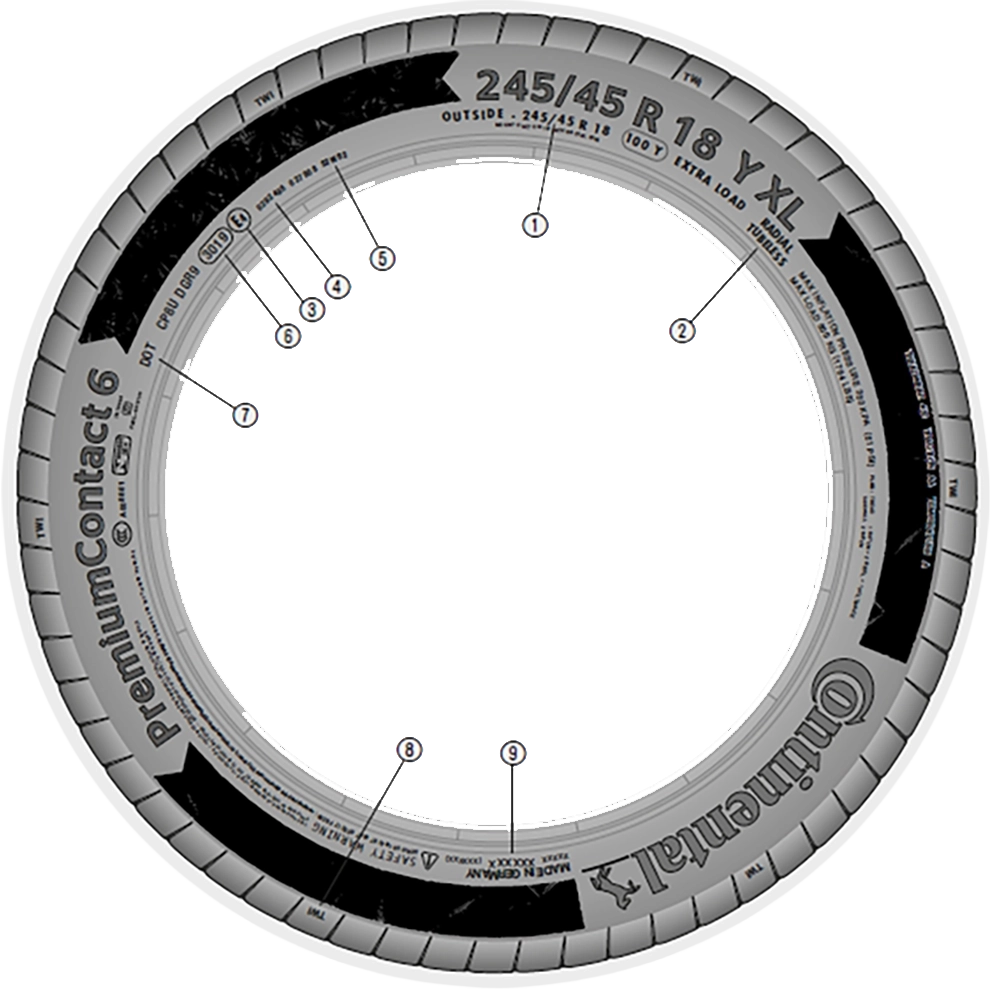
- Tyre specifications: In this example, 245/45 R 18 100 Y XL.
245 = nominal section width in mm.
45 = nominal aspect ratio (tyre height is 45% of tyre width).
R = symbol for radial tyre (or RF for run-flat tyres).
18 = rim diameter code.
100 = load index, with “100” meaning a maximum load of 800 kg.
Y = speed symbol, indicating a maximum speed of 300 km/h or 187 mph.
XL = Extra Load, showing a reinforced tyre for increased load capacity. - Tube type: Sample shown as Tubeless. TUBE TYPE tyres must be mounted with tubes.
- Country of homologation: Marking indicating accordance with UN regulations. Example: E4, where 4 = Netherlands.
- Approval number: Sample shown as 0292495. This is the approval number according to the relevant UN regulation.
- Compliance with noise: Sample shown as S2WR2. This indicates compliance with maximum permissible sound value S2, required wet grip, and maximum rolling resistance value R2.
- Production code: Sample shown as 3021. “30” means week 30 and “21” means year 2021.
- Department of Transportation: Sample shown as DOT, referring to the Department of Transportation in the USA.
- Tread wear indicator: Sample shown as TWI. These cross ribs are evenly spaced around the circumference in the longitudinal tread grooves and become level with the tread surface when the remaining tread depth reaches 1.6 mm.
Note: The image labels cover items 1–8 only. Country of origin, such as Made in Germany, may also appear on the sidewall but is not one of the numbered labels shown on this image.
Additional sidewall markings to know
- Tyre Specifications: 245/45 R 18 100 Y XL
- Tube Type: Sample reads Tubeless (TUBE TYPE tyres must be mounted with tubes).
- Country of Homologation: Marking indicating accordance with UN regulations (e.g., E4 where 4 = Netherlands).
- Approval Number: Sample reads 0292495 (Approval number according to relevant UN regulation).
- Compliance with Noise: Sample reads S2WR2 (indicates compliance with maximum permissible sound value S2, required wet grip, and max rolling resistance value R2).
- Production Code: Sample reads 3021 (“30” means week 30, “21” means year 2021).
- Department of Transportation: Sample reads DOT (Department of Transportation, USA).
- Tread Wear Indicator: Sample reads TWI (Cross ribs evenly spaced around the circumference in longitudinal tread grooves, becoming level with the tread surface when remaining depth reaches 1.6 mm).
- Country of Origin: Sample reads Made in Germany.
Need more motorhome help?
Browse more Roller Team Club guides for storage, levelling, water systems, and practical touring support.